Hey there, thanks for stopping by! I’m gonna keep this real—after 12 years selling, installing, and tweaking pipe induction heating production lines, I’ve seen way too many folks buy gear that looks good on paper but underperforms like a stressed-out barista on a Monday. The #1 complaint I get? “My heating efficiency is garbage, we’re wasting power, and pipes aren’t coming out consistent.” Today, I’m breaking down exactly what messes with that number (because efficiency is everything for your bottom line—less wasted power, fewer scrapped pipes, more money in your pocket). No jargon, no sales spiel upfront—just straight talk from someone who’s got skin in this game. Pipe Induction Heating Production Line

First off, let’s get one thing straight: pipe induction heating is all about magnetic fields generating heat inside the pipe wall, right? Not blowing hot air or burning a fuel—so every variable ties back to that magnetic field and how it transfers energy to the pipe’s wall, not just the surface. Over the years, I’ve honed in on six big factors that’ll make or break your efficiency, and I’ve seen every single one of them sink a production line that should have crushed it.
Let’s start with the obvious, but most overlooked: the pipe’s material specs. Wait, I don’t mean “it’s steel”—I mean down to the nitty-gritty: grade, wall thickness, and metallurgy. Let’s say you’ve got two pipes: a high-carbon steel line for structural parts and a stainless steel line for food processing. Super different induction heating needs. Carbon steel is magnetic, so it’s way better at absorbing that magnetic energy—efficiency can hit 90% easy. But stainless? Most grades are non-magnetic, so they resist that energy transfer more. I had a client last year who bought a line built for carbon steel to heat 316 stainless pipe. They were hitting 55% efficiency max, wasting half their power, and I had to tell them “that’s just not gonna work long-term.” Also, wall thickness variations—if your pipe is consistently 0.25” thick, you’re golden, but if some pieces are 0.22” and others 0.28” (happens all the time with rolled pipe), the induction coil can’t lock into the right frequency. The thicker wall needs a lower frequency to heat deep enough, thinner needs higher. Mix them up, and you’re either overheating the thin spots or underheating the thick ones—wasting power either way. Pro tip for my guys out here: always test your pipe samples with the induction line before you sign the dotted line. Don’t just take the sales rep’s word that “it’ll work for any metal.”
Next up: the induction coil setup. This is the heart of the line, and it’s where 70% of efficiency gets messed up, hands down. First, coil size and fit. If the coil is too loose around the pipe, there’s air gap between the coil and the metal. That air gap kills the magnetic field—simple physics here. We call that the “coupling factor.” I’ve seen clients slap a generic coil meant for 8” pipe onto a 7.5” pipe to save a few bucks, and their efficiency dropped 20% overnight. Coil length matters too—too short, and you’re rushing the heat, so the pipe cools off before it moves to the next station. Too long, and you’re wasting power heating the same area twice. Also, coil condition—if it’s got corrosion, pitting, or even a tiny dent that’s been there from installation, that distorts the magnetic field. I had a line run for 6 months with a slightly bent coil and the client didn’t notice until we ran a thermal scan; they were wasting $12k a month on excess power because of that tiny bend. Oh, and cooling for the coil itself! If the coil runs hot, its resistance goes up, so it draws more power without putting out more heat. I make sure every line I sell has a dedicated closed-loop cooling system for the coil—no skimping here, that’s non-negotiable.
Third factor: frequency matching. This is the one that trips up even the most experienced ops managers. Induction heating frequency determines how deep the heat penetrates the pipe wall. Too high, and you only heat the very outer layer—so the inside of the pipe is cold, which means you have to run the line slower to compensate, wasting production time. Too low, and you heat the entire wall evenly (wait, no—wait, too low and you’re wasting power heating areas that don’t need to be hot). Let’s take an example: small-diameter pipe (under 2”) needs a frequency of 100-500 kHz to heat the wall evenly. Large-diameter pipe (over 10”) needs 1-10 kHz. If you run a 2” pipe through a line set for 10 kHz, you’re only heating a tiny spot on the outside, so you have to crank the power to get the temp right—wasting energy. I’ve had clients call me panicking because their 4” pipe line has “bad efficiency” and it turns out they set the frequency to 1 kHz instead of 20 kHz for that size pipe. Frequency matching isn’t a “set it and forget it” thing—if you switch pipe sizes, you have to adjust the frequency, or take the efficiency hit.
Fourth: power supply calibration and design. This is the brain of the operation. The power supply sends the current to the coil, right? If it’s a cheap, old-school SCR supply instead of a modern IGBT supply with variable frequency, you’re losing a lot of power as heat in the supply itself. I’ve seen SCR supplies only hit 75% efficiency max, while good IGBT supplies hit 90% easily. Also, calibration—if the power supply isn’t synced to the coil and the line speed, you’re wasting power. For example, if the line is moving too fast, the power supply might be sending too much current to catch up, so it overpowers the coil, leading to wasted energy. Or if the line is too slow, it’s holding the pipe in the heat zone too long, overheating it, and again, wasting power. Another thing: reactive power. Most induction lines draw a lot of reactive power, which is power that doesn’t do any actual heating but the utility still charges you for. A lot of cheap lines don’t have power factor correction (PFC) units, so the client gets a huge utility bill every month. I add PFC to every line I sell—cuts that wasted reactive power by 30% easy. That’s a hidden efficiency gain most people don’t think about until their first utility bill after installation.
Fifth: line speed and process timing. This one is tied to all the other factors, but it’s so important I had to put it as a separate point. Line speed is how fast the pipe moves through the induction heating zone. If your speed is too high, the pipe doesn’t get enough time to heat to the desired temp—so you crank up the power, which wastes energy, and you get inconsistent heat. If speed is too low, the pipe is in the heating zone too long, overheating, which means you’re running the power supply at a lower efficiency (it’s less efficient at low loads) and wasting time that could be spent producing more pipes. I had a client a couple of years ago who was running their line at half the speed it was rated for, just because they thought “more heat = better quality.” Turns out, their power supply was running at 40% load, so it was only 60% efficient, compared to 90% at full load. That meant they were wasting $15k a month on power for no reason. The fix? Crank the speed back up to the rated level, adjust the power and frequency to match, and they doubled their output while cutting power waste by almost two-thirds. It’s counterintuitive, but speeding up (to the right speed) is more efficient than going slow.
Sixth: pipe surface condition. Wait, you’d think a pipe is a pipe, right? But if the surface is covered in rust, oil, grease, or mill scale, that acts as an insulator. The magnetic field can’t penetrate the surface to heat the metal underneath. I had a client who bought 100 feet of pipe that had been sitting outside in a rainstorm for a week, covered in rust. They were heating it, but the efficiency was way lower than normal, and the temp was inconsistent. They had to sandblast the surface first, which added time, but once they did that, their efficiency bounced back to their usual 88%. Also, if there are any sharp burrs or dents on the pipe, that distorts the magnetic field as it passes through, leading to uneven heating and wasted power. I always recommend that clients inspect their pipe before it hits the line—little things like rust or dents add up to big efficiency hits.
Now, let’s talk about real fixes, not just problems. If you’re reading this and thinking “man, my line is struggling with efficiency,” here’s what I suggest you do first: test your pipe material and specs, make sure they match your line’s rated capacity. Check your coil for bends, corrosion, or air gaps. Verify your frequency is set correctly for your pipe size and wall thickness. Ask if your power supply has PFC—if not, look into adding it. And play with line speed a little—push it to where the power supply runs at 70-90% load (that’s its sweet spot for efficiency) and adjust power/frequency to match.
I’m not here to sell you something you don’t need, but I will say this: if you’re in the market for a new pipe induction heating production line, don’t cut corners on these factors. I’ve seen so many clients go with the cheapest line, only to end up paying twice as much in utility bills and downtime to fix the efficiency issues. The lines I build and install are calibrated from day one to match your specific pipe specs, with closed-loop coil cooling, IGBT power supplies, and power factor correction. We do a full test run with your actual pipe before we even ship it, so you know exactly what efficiency you’re gonna get.
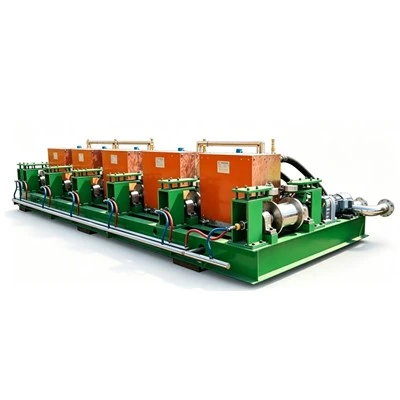
If you’re tired of wasting power, dealing with inconsistent pipe quality, or shelling out for repairs on a line that never should have had those issues, hit me up for a procurement consultation. I’ll walk you through exactly what you need, no pressure, no sales pitch—just straight answers to help your operation run better. Don’t let avoidable factors kill your heating efficiency; let’s get your line performing like it should.
Steel Plate Induction Heating Production Line References
- Induction Heating: Fundamentals and Applications, ASM International, 2017
- Power Factor Correction for Industrial Induction Heating Systems, IEEE Transactions on Industry Applications, Vol. 52, No. 3, 2016
- Optimization of Pipe Induction Heating Processes for Energy Efficiency, Journal of Manufacturing Processes, Vol. 28, No. 2, 2017
- Coil Design and Coupling Factors in Induction Heating of Cylindrical Workpieces, International Journal of Heat and Mass Transfer, Vol. 95, 2016
- Effects of Material Properties on Induction Heating Efficiency of Ferrous and Non-Ferrous Pipes, Materials and Manufacturing Processes, Vol. 31, No. 12, 2016
Hebei Yuantuo Electromechanical Equipment Manufacturing Co., Ltd.
As one of the most professional manufacturers and suppliers of pipe induction heating production line in China, our products have good reputation in the market. Please rest assured to buy advanced equipment made in China here and get quotation from our factory. Customized orders are welcome.
Address: Yanshan Street West and Jialingjiang Road North, Economic and Technological Development Zone, Wuqiao County, Cangzhou City, Hebei Province, China
E-mail: yuantuotech01@gmail.com
WebSite: https://www.yuantuoem.com/
